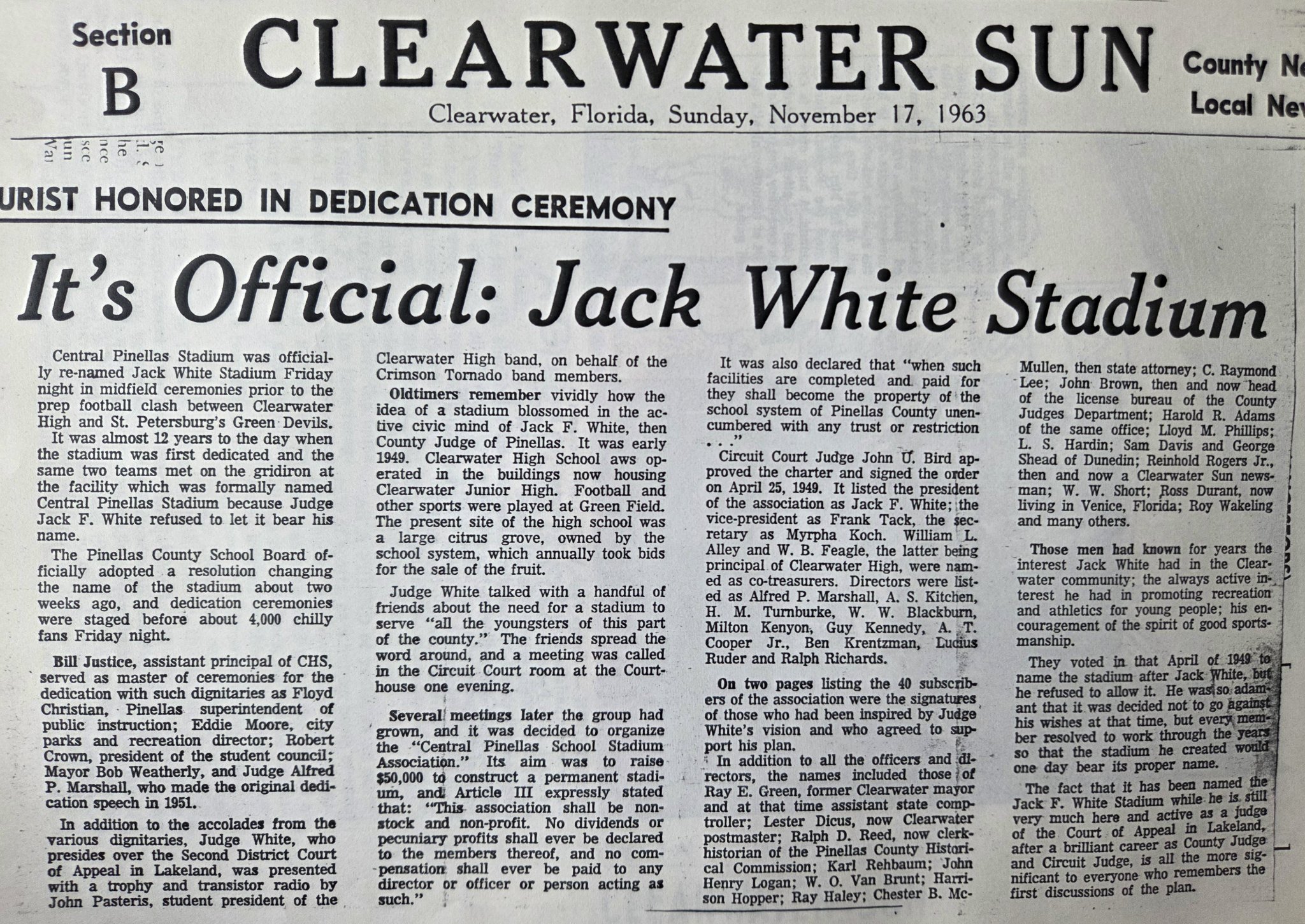
It's Official: Jack White Stadium
Transcribed from the Clearwater Sun, Sunday, November 17, 1963, Section B, via the Clearwater Public Library's archive.
JURIST HONORED IN DEDICATION CEREMONY
Central Pinellas Stadium was officially re-named Jack White Stadium Friday night in midfield ceremonies prior to the prep football clash between Clearwater High and St. Petersburg's Green Devils.
It was almost 12 years to the day when the stadium was first dedicated and the same two teams met on the gridiron at the facility which was formally named Central Pinellas Stadium because Judge Jack F. White refused to let it bear his name.
The Pinellas County School Board officially adopted a resolution changing the name of the stadium about two weeks ago, and dedication ceremonies were staged before about 4,000 chilly fans Friday night.
Bill Justice, assistant principal of CHS, served as master of ceremonies for the dedication with such dignitaries as Floyd Christian, Pinellas superintendent of public instruction; Eddie Moore, city parks and recreation director; Robert Crown, president of the student council; Mayor Bob Weatherly, and Judge Alfred P. Marshall, who made the original dedication speech in 1951.
In addition to the accolades from the various dignitaries, Judge White, who presides over the Second District Court of Appeal in Lakeland, was presented with a trophy and transistor radio by John Pasteris, student president of the Clearwater High band, on behalf of the Crimson Tornado band members.
Oldtimers remember vividly how the idea of a stadium blossomed in the active civic mind of Jack F. White, then County Judge of Pinellas. It was early 1949. Clearwater High School was operated in the buildings now housing Clearwater Junior High. Football and other sports were played at Green Field. The present site of the high school was a large citrus grove, owned by the school system, which annually took bids for the sale of the fruit.
Judge White talked with a handful of friends about the need for a stadium to serve "all the youngsters of this part of the county." The friends spread word around, and a meeting was called in the Circuit Court room at the Courthouse one evening.
Several meetings later the group had grown, and it was decided to organize the "Central Pinellas School Stadium Association." Its aim was to raise $50,000 to construct a permanent stadium, and Article III expressly stated that: "This association shall be without stock and non-profit. No dividends or pecuniary profits shall ever be declared to the members thereof, and no compensation shall ever be paid to any director or officer or person acting as such."
It was also declared that "when such facilities are completed and paid for they shall become the property of the school system of Pinellas County unencumbered with any trust or restriction . . ."
Circuit Court Judge John U. Bird approved the charter and signed the order on April 25, 1949. It listed the president of the association as Jack F. White; the vice-president as Frank Tack, the secretary as Myrpha Koch. William L. Alley and W. B. Feagle, the latter being principal of Clearwater High, were named as co-treasurers. Directors were listed as Alfred P. Marshall, A. S. Kitchen, H. M. Turnburke, W. W. Blackburn, Milton Kenyon, Guy Kennedy, A. T. Cooper Jr., Ben Krentzman, Lucius Ruder and Ralph Richards.
On two pages listing the 40 subscribers of the association were the signatures of those who had been inspired by Judge White's vision and who agreed to support his plan.
In addition to all the officers and directors, the names included those of Ray E. Green, former Clearwater mayor and at that time assistant state comptroller; Lester Dicus, now Clearwater postmaster; Ralph D. Reed, now clerk-historian of the Pinellas County Historical Commission; Karl Rehbaum; John Henry Logan; W. O. Van Brunt; Harrison Hopper; Ray Haley; Chester B. McMullen, then state attorney; C. Raymond Lee; John Brown, then and now head of the license bureau of the County Judges Department; Harold R. Adams of the same office; Lloyd M. Phillips; L. S. Hardin; Sam Davis and George Shead of Dunedin; Reinhold Rogers Jr., then and now a Clearwater Sun newsman; W. V. Short; Ross Durant, now living in Venice, Florida; Roy Wakeling and many others.
Those men had known for years the interest Jack White had in the Clearwater community; the always active interest he had in promoting recreation and athletics for young people; his encouragement of the spirit of good sportsmanship.
They voted in that April of 1949 to name the stadium after Jack White, but he refused to allow it. He was so adamant that it was decided not to go against his wishes at that time, but every member resolved to work through the years so that the stadium he created would one day bear its proper name.
The fact that it has been named the Jack F. White Stadium while he is still very much here and active as a judge of the Court of Appeal in Lakeland, after a brilliant career as County Judge and Circuit Judge, is all the more significant to everyone who remembers the first discussions of the plan.